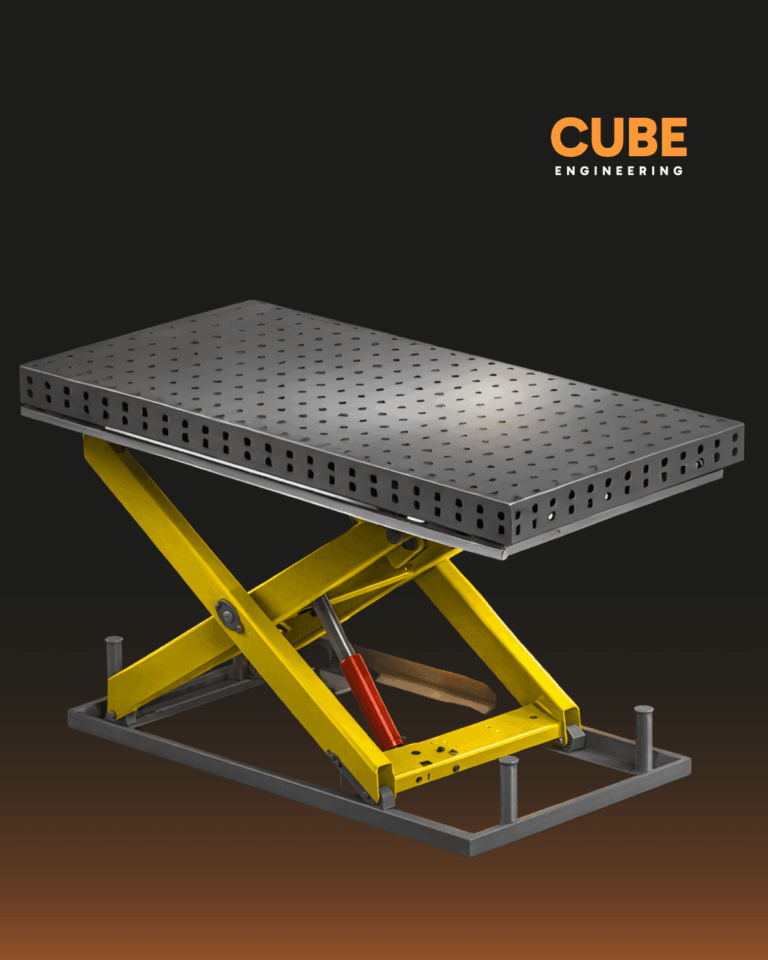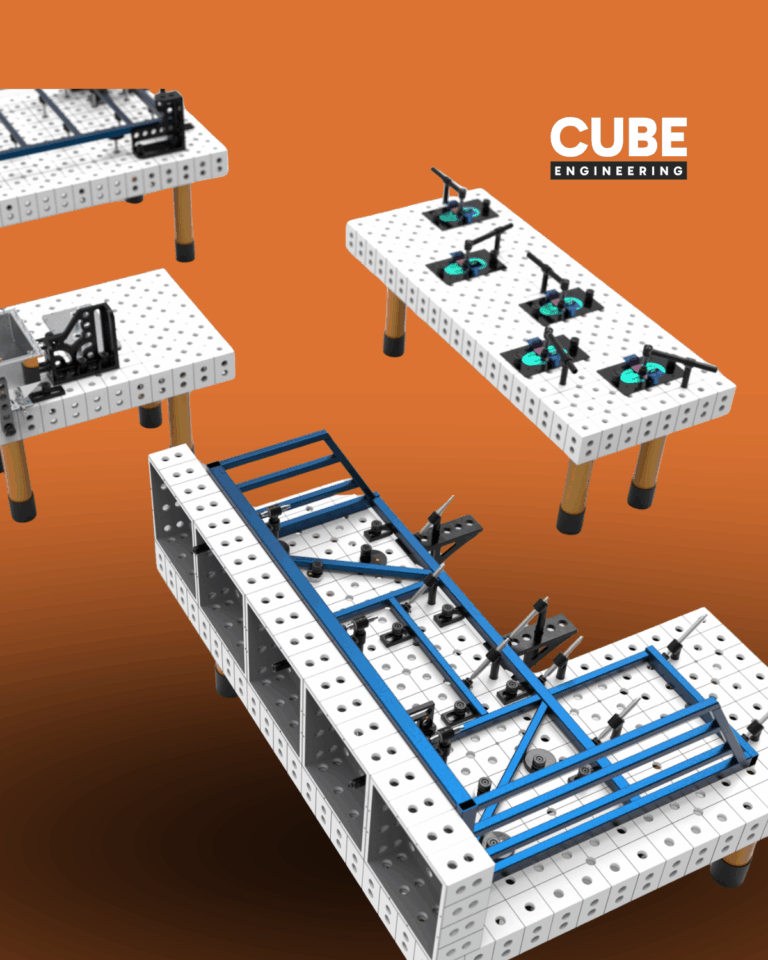

The welding industry worldwide is undergoing a dynamic transformation – the global market for welding products is growing, and automation and digitalization of processes are becoming key trends. In Poland, an additional challenge is the shortage of qualified welders, which increases the need for flexible solutions. At CUBE Engineering, we are responding to these changes by designing the modular CUBEWELD welding table system, which is ready for integration with new technologies, automation, and welding robots.
According to the report “Welding Products Market – Global Market Size, Share, and Trends Analysis Report – Industry Overview and Forecast to 2032” (Data Bridge Market Research, 2024), the global welding products market reached a value of USD 15.47 billion in 2024 and is expected to grow to USD 23.27 billion by 2032. This represents steady growth at a CAGR (Compound Annual Growth Rate) of 5.23%. The main drivers of the market include: automation and robotization of welding processes, the digitalization of manufacturing and the increasing use of smart welding technologies, the growing importance of ergonomics and welder safety, as well as the use of advanced materials – including high-strength steels, composites, and specialty alloys. The highest demand for welding technologies comes from sectors such as construction, automotive, energy, and shipbuilding. The Asia-Pacific region remains the key growth area, especially China and India, where infrastructure investments and the development of heavy industry are boosting demand for advanced welding equipment.

Welder shortage in Poland — labor market challenges
However, global trends in Poland are met with labor market challenges. According to the ManpowerGroup report “Talent Shortage 2023”, as many as 72% of Polish employers struggle to find employees with the right qualifications. Meanwhile, the CareersInPoland report “Recruitment trends and challenges in Poland – what sectors will be hiring in 2025” indicates that 25% of companies are seeing a further decline in the availability of skilled labor compared to 2023. Staffing shortages – especially in the welding profession – are accelerating the adoption of welding automation, process robotization, and investments in modern welding tables that support production efficiency and stability.
SCHWEISSEN & SCHNEIDEN 2025 — key welding market trends

Our observations from the SCHWEISSEN & SCHNEIDEN 2025 trade fair only confirmed these conclusions. It was clear at the event that smart welding is no longer a futuristic buzzword—it’s becoming an everyday reality. Manufacturers showcased real-time welding monitoring systems, AI-based solutions, and robots working alongside humans in cobot models. As a result, companies can react to errors faster, reduce costs, and improve weld quality. Importantly, these technologies are no longer reserved just for the biggest players—they’re increasingly reaching smaller and medium-sized businesses as well.
The second major trend is sustainable welding. We saw many solutions designed to save materials, reduce emissions, and extend the life of tools and workbenches. There was also a lot of discussion about local supply chains—shortening the path from production to customer means not only lower costs and faster turnaround, but also a smaller environmental footprint. This is the direction we’re taking ourselves, which is why we were proud to show that CUBEWELD is made in Poland and our modules can be regenerated and reused.
Future Hub and industry discussions
The Future Hub zone made a huge impression on us. This was where start-up representatives, engineers, and industry leaders met—a true space for knowledge exchange: from presentations of new materials, through demonstrations of automated welding systems, to talks about the future of the workforce in the sector. The most prominent solutions were modular and scalable ones that can be easily tailored to the needs of any company—from small workshops to global production lines.
The presentations at “Future Hub” were very diverse, but importantly, they weren’t just technical talks—they were discussions about the future of welding: about processes counted in millions of cycles, about materials, and about people. Here are the talks that stood out to us:
• Benedikt Allebrodt (Durum Verschleißschutz GmbH) — “Innovative materials for thermal coating,” focused on new materials used in thermal coatings that protect against wear and corrosion.
• Samuel Mann (welded.io) presented a networked welding fume sensor solution that reveals invisible health risks for workers. The system protects people and saves energy by intelligently controlling ventilation and extraction only when needed.
• Juha Ensio Kauhanen (Cavitar Ltd., Savon ammattiopisto, Savo Vocational College in Finland) demonstrated how a welding camera can support welding education. It allows you to watch and record the welding process live, making it easier to learn, quickly correct mistakes, and better connect theory with practice.
A highlight was the international panel discussion on resource-saving cleaning processes; experts—including Olaf Reuter (Reuter)—shared practical examples of cleaning methods that are resource-friendly.
It’s worth noting that most presentations were led by practitioners and implementation specialists. As a result, the proposed solutions are actionable strategies that can be applied on the shop floor today.
For us, the trade fair confirmed that the direction in which we’re developing CUBEWELD aligns with global trends. Flexible modules, easy integration with robots and automation, and durability based on advanced processing technologies—these are the elements the industry needs most right now. We left Essen convinced that our solutions not only address market challenges but are also part of a new standard in welding.